

In emergency and urgent care environments, speed of intervention is critical. However, when addressing patient restraint and transfer in emergency situations, the priority is not only acting quickly, but also doing so with safety, control, and operational efficiency.
This need becomes even more relevant when the patient presents aggressive behaviour, agitation, or disorientation, increasing the risk during handling and mobilization. In this context, one of the most delicate moments is patient transfer between stretchers or beds, particularly in emergency stretchers.
How can a safe transfer be ensured without compromising the safety of either the patient or the healthcare team?
Caring for patients with psychomotor agitation or aggressive behaviour poses significant challenges in emergency departments, ambulances, and hospital settings.
Among the main risks in patient restraint in emergency situations are:
- Loss of control of the patient during mobilization
- Accidental injuries during transfer
- Risk to healthcare professionals
- Interruptions in care protocols
- Increased intervention time
Additionally, many traditional immobilization systems require partial or complete release of patient restraints during the transfer process, significantly increasing the risk of incidents, particularly in patients who are agitated, disoriented, or exhibit unpredictable behaviour. This intermediate handling phase represents a critical point for both patient and healthcare team safety, as any loss of control may result in falls, injuries, or operational risk situations.
In this context, the ability to transfer patients on emergency stretchers without removing restraints represents a significant advancement in patient safety. This approach ensures continuous control of the patient during mobilization, reducing intervention times, minimizing exposure to unnecessary risks, and improving coordination among healthcare teams in high-pressure situations.
This approach enables:
- Continuous control of the patient at all times
- Reduced risk of aggressive reactions
- Improved safety within the care environment
- Optimized intervention times
- More efficient patient care
For this reason, an increasing number of healthcare facilities are opting for systems that integrate patient restraint and immobilization with safe transfer capabilities. Restraint systems for emergency stretchers:
What should they meet to ensure safe patient restraint in emergency care?
1. Rapid application: Allowing quick deployment in critical situations.
2. Secure and comfortable restraint: Ensuring immobilization without causing harm or discomfort.
3. Adaptability to patients and stretchers: Compatible with different patient profiles and types of emergency stretchers.
4. Transfer without releasing restraints: A key factor in reducing risks during patient transport.
5. High resistance and durability: Materials designed for intensive healthcare use. Salvafast® Transfer: a solution for patient restraint and transfer
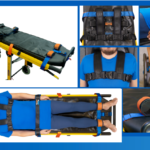
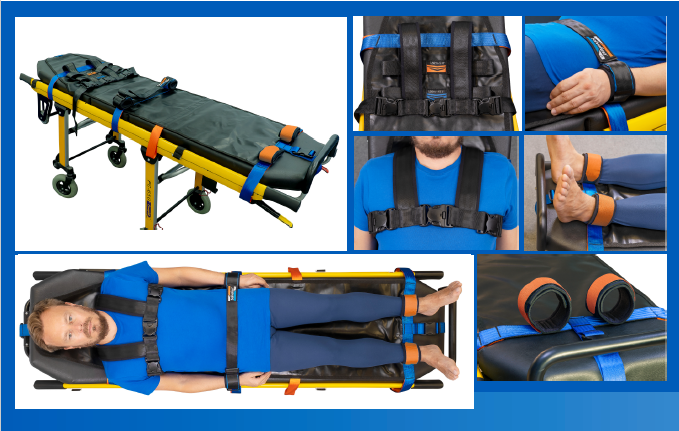
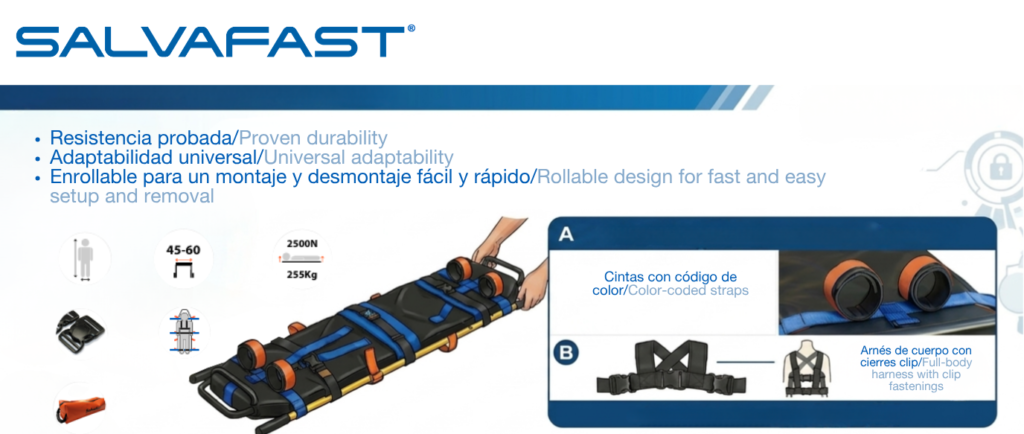
The Salvafast® Transfer is designed for rapid restraint and safe transfer of aggressive or disoriented patients on emergency stretchers. Its main differentiating value is that it allows patient transfer without releasing restraints, ensuring continuous control at all times.
Key features
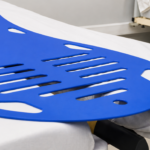
- Sliding base that facilitates patient transfer
- Harness system with multiple fixation points
- Wrist and ankle restraints with double Velcro® fastening system
- Compatible with stretchers from 45 to 60 cm width
- Universal size
- Single-piece design for fast deployment
This system is designed to meet the real needs of emergency care environments, ensuring both safety and efficiency. Implementing specific restraint and transfer systems in emergency settings provides clear benefits:
- Improved safety during patient mobilization
- Reduced risks for both patients and healthcare professionals
- Optimized care delivery time
- Enhanced emergency care protocols
- Adaptability to multiple healthcare environments
The evolution of patient restraint systems for emergency stretchers is enabling a shift towards safer, more efficient, and more professional care. Having solutions that integrate both restraint and transfer is no longer an option, but a necessity in environments where every second counts.
Discover how to improve patient safety in restraint and transfer in emergency care with Salvafast® Transfer